Short form digital storytelling is a wondrous combination of what is relevant in our modern, technological age. It is a mashup of short form stories – those which strive to move our souls with only perhaps a dozen pages or minutes of content, and digital media – a term which embodies the plethora of technology available on our devices. Together, these two things create a unique form of the story, one which is on the cutting edge of what we can do, and one which is perfect for the person with little time (which we often are).
You may be saying, “But Mr. Mitchell, I don’t know which short form digital story to read, it’s all too much!” Well, fear not, because in this article, I will be rating four short form digital stories from a group of nine (which were curated by my professor) to save you the effort and time of choosing on your own! These stories are Queers in Love at the End of the World, Ghosts, With Those We Love Alive, and Seven short stories about drones.
Number 4: Ghosts – by Vauhini Vara
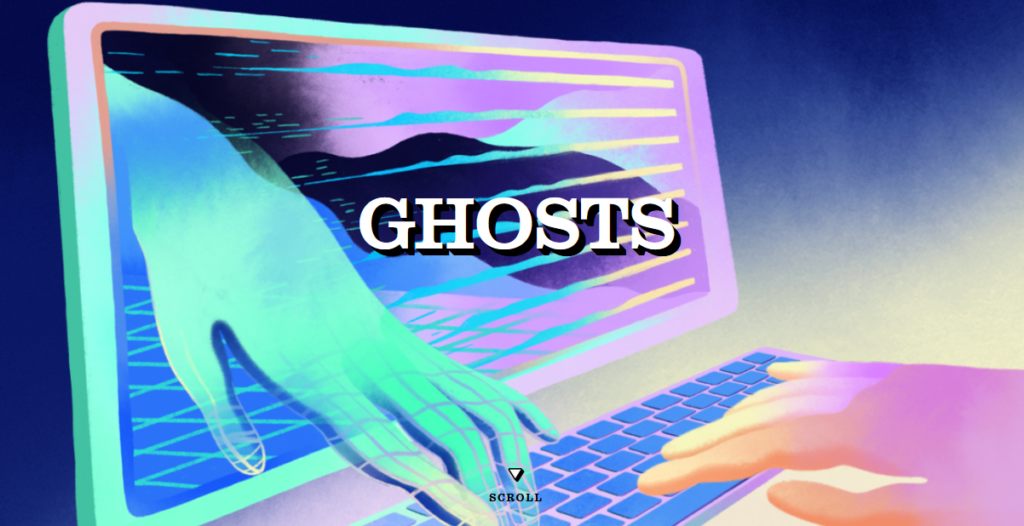
The frankly beautiful cover of the piece.
Ghosts is a piece about grief, and the processing of it – or the lack of being able to, more accurately. In the work, Vara progressively types out the story of her sister’s passing, while GPT-3 (an AI language processor and generator) finishes it. While she starts out struggling to type more than a couple of sentences, eventually, the whole story comes to light.
Pros
The presentation of the story is done very well. The graphics are high quality and stylized, with much effort clearly put into them. As the piece progresses, the dividing art piece that acts as a section divider slowly changes, seemingly to represent man and machine getting closer – a representation of what the work tries to be.
The human prose is very well written. It is a story of being unable to move on, and seemingly ends with Vara still unable to move on, which I think is a bold choice.
Cons
My biggest issue with this piece is the usage of GPT-3. While reading the work, I had to ask myself, “Why is this even here? What does this do for the story that another person, or even the lack of anything else, couldn’t? The point of the story is stated clearly in the introductory paragraph – to work through grief. I don’t think that the robot furthers that goal in a unique way. It seems like it’s there just because the author wanted to play with a shiny new toy.
The author treats GPT-3 as a human. Then, why not just use a human to finish the piece in an incorrect manner? The AI isn’t doing some super special AI thing that only the AI can do, it’s just doing a worse job at something that could be done better by a person. There is tons of weird prose that appears as if GPT-3 had a stroke and died halfway through writing:
“I’ve turned the space station into a spaceship. I’m a ghost, and I’m in a spaceship, and I’m hurtling through the universe, and I’m traveling forward, and I’m traveling backward, and I’m traveling sideways, and I’m traveling nowhere. I’m hurtling through the universe, and I’m a ghost, and I’m in a spaceship, and I’m hurtling through the universe, and I’m a ghost, and I’m in a spaceship, and I’m hurtling through the universe, and I’m a ghost, and I’m in a spaceship, and I’m hurtling through the universe, and I’m a ghost, and I’m in a spaceship”
Does the weird prose serve any purpose? No, it’s just the AI having a stroke and dying. This is why I think a person could have done this better. If it was a person continuing the stories, then they could have actually processed and related to the author’s grief. They might have just made up a continuation of the author’s story, but this notion can then be challenged by the main author, with a newfound invigoration to correct what’s wrong. Now, you may say, “But GPT-3 is doing the same! It can make up wrong information as well!” Well, I think that a person could do it better. A person won’t go off on weird tangents that make you look at your screen in confusion, and a person has actually processed grief themselves before. They can actually write a thoughtful continuation in comparison to an AI, which feels nothing because it is a random sentence generator that’s just good enough to appear human.
The section divider art is really odd in its contents. It depicts man and machine coming closer together slowly, clearly representing some type of connection being formed over time though understanding. My question is: “What does this have to do with anything?” I thought the story was about trying to work through grief, not becoming friends with the illusionary man inside your computer. If the author wanted this to be a focal point of the piece, then why didn’t she include it literally anywhere else. This is why GPT-3 feels shoehorned in! It’s because the author just wanted to play with the hot new thing, and not focus more on the thematic consistency of her work.
Verdict
I give this piece a 5/10. The author’s prose is well written and on point, but the machine generated segments are offputting and offtopic.
Number 3: Queers in Love at the End of the World – by Anna Anthropy
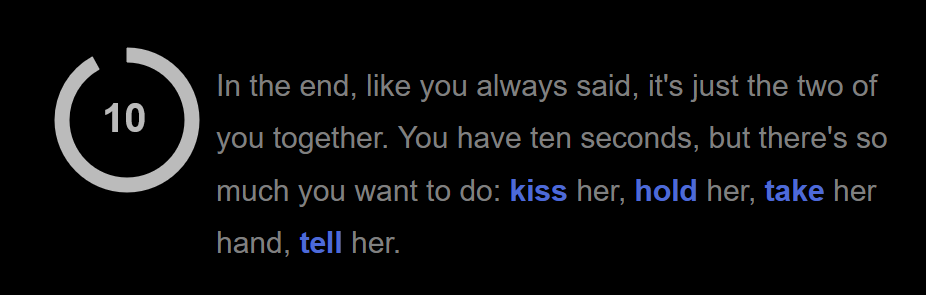
The four options which the game starts with, and the timer.
Queers in love at the End of the World is a short game. It’s only ten seconds long, in fact, indicated by a time and bar quickly going down at the left hand side of your screen. It is a story about love and what love entails, and what matters at the end of the world.
Pros
This piece is short and sweet, and that’s the point, of course. It asks you the question, “What do you do with the person you love with the time you have left?” By the nature of its timer, it encourages you to speed-read through its dialogue and prose, emulating very well the limited time that would be available in an apocalyptic scenario.
The work also does a good job encapsulating the different aspects of love – there is the emotional, the physical, and the sexual. They are all there. And it doesn’t judge you for choosing any one in particular. It’s ok if you want to simply talk to your partner. It’s ok if you just want to hold them. It’s ok if you want to have sex with them. It treats them as equals, and by doing so it encapsulates the beauty of a balanced relationship – one in which you are in tune with every aspect of your partner, and one in which your partner is in tune with you.
Cons
The most interesting aspect of this piece is unfortunately its only downside – that being the timer. I din;t have any problems with it particularly, but if you read slowly or have a hard time reading, then this game isn’t for you. This isn’t the game’s fault, though. It is simply a side effect of artistic choice.
Verdict
This digital story is short and sweet, and does what it wants to do well in that short period of time. I give it an 8/10.
Number 2: Seven short stories about drones – by Teju Cole
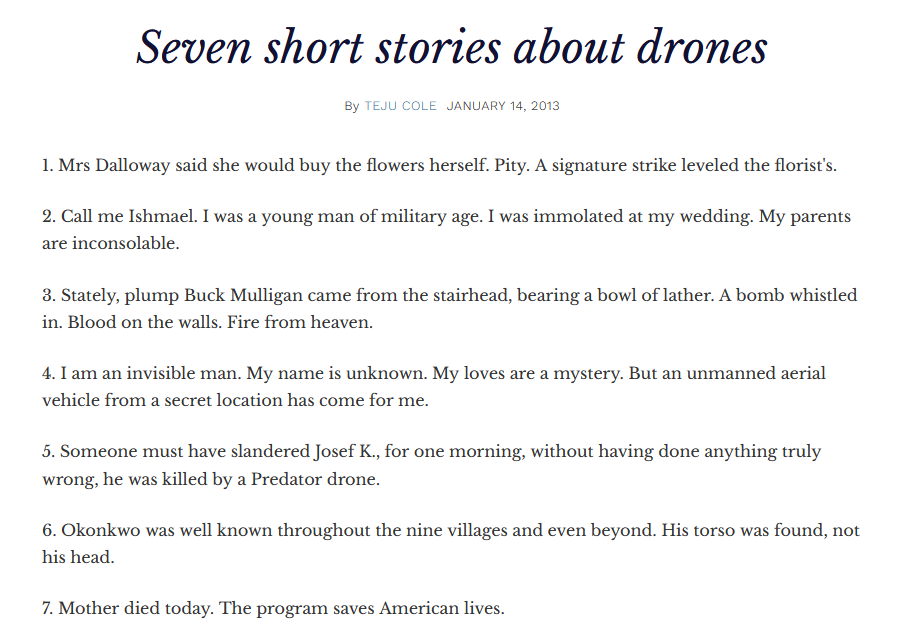
The piece in its entirety.
Seven short stories about drones is a piece about being killed by American drones. It describes in succinct sentences the brutality and horror of being on the receiving end of an unthinkable war machine.
Pros
This piece has incredibly compact and interesting writing. It uses a variety of techniques, from alliteration, to staccato sentences, to parallelism, all to frame remote warfare in an absolutely terrifying picture.
The stories’ shortness really works wonders. They doesn’t drag on, and they doesn’t mull about. They simply do what they need to to, and then end. You can read this in a minute, and come away thinking “Wow, never thought about the overwhelming terror that seeps into everyday life from the mere existence of autonomous American drones.”
Cons
A shortcoming of short form writing is that it is short, and not everything that could be in the piece will be in it. Keeping this in mind, I will simply state what long form writing has in advantage over short form. In a long form piece, we have the ability to get invested in a character over longer periods of time, and when these characters die, it hits us harder than if we were introduced to them a sentence ago. Long form writing can also go into more depth. It can detail the industry making killer drones, the people who profit from killer drones, and the effects of American interference in the Middle East. I don’t think that all this is a shortcoming of this piece. It does what it needs to do splendidly, and makes us care very quickly. This all is simply a shortcoming of the form, and I needed something to criticize.
Verdict
This is an 9/10. It does what it sets out to do very well.
Number 1: With Those We Love Alive – by Porpentine
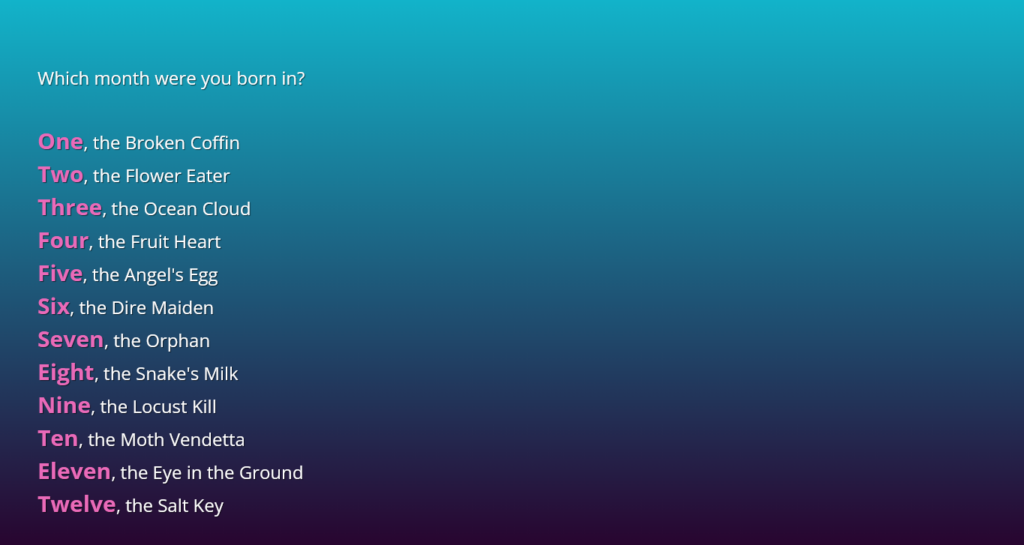
The starting screen of the game, representative of every other screen to come.
With Those We Love Alive is a very strange game. It takes place in an otherworldly society, with strange customs, strange people, and strange occurrences. Your objective is simple: Craft objects for the Skull Empress in your workshop. You can click purple text to cycle options, and click pink text to continue through the story. In between request, the player can explore the palace grounds in which they are staying.
Pros
The world of this game is wonderfully weird. It makes no sense, and yet tells a meaningful story. The Skull Empress is a strange mishmash of beings, peculiarly chosen by the player themself, just like the materials of the objects you forge for the empress. The world is filled with temples for silent gods, plants pouring strange fluids into the ground, and parents who wrench the dreams from your mind. Your best friend carries potions and elixirs at their side. Every so often there is a sort of blooming where a bunch of strange creatures erupt everywhere, and everyone just squishes these beings with joy. The music is eerie. It draws you in through its other-worldliness, leading you to want to experience the story through to its conclusion.
The story itself is very simple: the eventual personal rebellion against an oppressive world after years of dealing with its heaviness. The story is very queer in its themes: you and your friend are transgender women, and it is very easy to see where the allegory lies after you realize this. It is a simple, yet effective and never-aging tale.
Cons
The story in this game is very simple. Don’t go expecting a narrative epic or a mind bender. Just relax, and enjoy the ride.
The exploration aspect of the game is rather limited. The environment and text descriptions of the various places you can visit largely stay the same. I believed they changed somewhat during my playthrough, but for most days in the game you might immediately just sleep to skip the day. Apparently dead people just start appearing in places in the world, but I don’t recall encountering this in my playthrough. You can build a telescope for your balcony in the workshop over the course of a few days, which I though was fun. It would have been interesting to see more slow tasks like this.
The interface is very simple, just text with a gradient background. It isn’t the prettiest, but it wasn’t a problem for me at all.
Verdict
With Those We Love Alive is a 9/10. Its unique setting sets it miles apart from anything else, and it manages to tell a simple story extremely well.
Reviewing Approach
As a reviewer of these stories, I tried to review them through a simple metric, that being how good the art is at what it’s trying to do. A simple story isn’t bad, as long as it executes its concept well. A complex piece isn’t good, if it fails to understand its own point.
I gave each piece a pros and cons section, as it was the simplest way to divide my positive and negative thoughts, and it also makes it easier for the reader to find which of my thoughts they want to look at.
Additional Recommendation
If you like my taste in digital stories, then also check out this ARG I enjoyed (through the form of a video analysis of it). The video series covering it isn’t that long, and I think the concept of the ARG is very interesting.