Pride and Penthouses, by ChatGPT
It was a universally acknowledged truth that a wealthy resident in Block H-17 must be in want of absolutely nothing—except, perhaps, solitude. Unfortunately, solitude had been quietly phased out of the Huxley Communal Residence in 2059, along with private kitchens and the right to ignore your neighbors.
Mrs. Bennett of Apartment 4B knew this better than anyone. She began each morning scrolling the building message board and each afternoon panicking aloud about it.
“Jane,” she called across the shared kitchen, “have you seen the new resident listing? Penthouse level. Personal greenhouse. No assigned roommates.”
Jane Bennett, chopping lab-grown vegetables with serene efficiency, nodded. “I noticed. His utilities usage is remarkably low.”
Mrs. Bennett clutched her smart bracelet. “Low usage! Sensible! Lizzy, did you hear that? A man who doesn’t waste resources. That’s practically a husband.”
Elizabeth Bennett removed her audio lenses slowly. “Or perhaps he simply dislikes the building’s holographic fireplace like the rest of us.”
This reasonable comment went entirely unappreciated. Mrs. Bennett immediately scheduled several “accidental” encounters with the newcomer, Mr. Fitzwilliam Darcy of the penthouse, citing community integration requirements.
Mr. Darcy arrived precisely on time, which was offense enough. He was tall, impeccably dressed, and wore the unmistakable expression of a man who had chosen communal living strictly for tax benefits.
“It’s very… lively,” he said, surveying the shared lounge, where residents debated water quotas and argued over whose turn it was to clean the drone docks.
Elizabeth observed him from the sofa. “He looks like someone who’s never had his laundry mixed with a stranger’s socks.”
Nearby, Mr. Charles Bingley from Apartment 7D was delighted by everything. He had moved in alongside Darcy and within a week had joined three committees, two dance collectives, and a historical book club dedicated to post-modernist pre-digital novels.
“I love it here!” Bingley said. “So many people! So many conversations! So many borrowed chargers!”
Jane smiled at him, and Mrs. Bennett mentally began planning a shared apartment expansion.
Miss Caroline Bingley, Charles’s sister, was less enthused. “Honestly,” she whispered to Darcy, “living below Level 6 feels terribly outdated.”
Darcy nodded gravely. “The noise alone may shorten my lifespan.”
Elizabeth, meanwhile, found herself encountering Darcy everywhere: trapped together during elevator maintenance, seated side by side in the silent meditation hall, and once—most memorably—during a heated argument with the malfunctioning food printer.
“You need to recalibrate the protein selector,” Darcy offered.
Elizabeth turned sharply. “And you need to recalibrate your manners.”
Their mutual dislike quickly became building gossip, complete with message-board debates and at least one unauthorized meme involving Darcy’s expression at the last potluck.
Things worsened when George Wickham of Apartment 3F—handsome, charming, and permanently between jobs—confided in Elizabeth about Darcy’s alleged wrongdoings. According to Wickham, Darcy had unfairly blocked his access to building credits and had him removed from a premium charging station.
Elizabeth believed him. Darcy seemed exactly the sort of man who would weaponize bureaucracy.
The truth emerged during the Annual Communal Gala, held in the rooftop oxygen garden. Residents mingled under artificial stars while reluctantly participating in dance competitions, synchronized to the latest hits. synchronized dance projections.
Darcy, visibly uncomfortable, finally sought Elizabeth out.
“I was wrong,” he said stiffly. “I judged this place—and you. I thought independence meant keeping people at a distance. I see now that I was mistaken.”
Elizabeth stared. An apology? Direct? In public?
“And,” he added, lowering his voice, “Wickham diverted shared housing credits for personal use. The records are public now.”
By morning, Wickham had disappeared, Mrs. Bennett was loudly discussing apartment mergers, Jane and Bingley were co-chairing the Community Wellbeing Committee, and Elizabeth found herself walking with Darcy through the humming corridors.
The building buzzed as always—with voices, footsteps, and shared lives.
But for the first time, Elizabeth didn’t resent it.
After all, even in 2070, pride could still be dismantled, prejudice reconsidered, and love discovered—especially when everyone lived behind the same thin walls.
Analysis of ChatGPT in a Storytelling Setting
This project was very interesting, and by interesting I mean it was like watching a beaver who was simultaneously drunk and high attempting to make a painting (the beaver would still do better than ChatGPT). This may be a slight exaggeration, but I will now go into detail on why I don’t think ChatGPT, or other AIs, are an effective tool for writers.
Prompts
The prompt for this AI-generated story was: “can you write a ~600 word story which is a spoof on pride and prejudice but all the characters live in a communal housing block in the year 2070,” followed by “rewrite this but make the characters not robots, edit the entire story to reflect this change” as the first version had the characters as robots for some reason. After this, I had a presentable version of the story.
General Text
The general text is passable, in my opinion. There’s nothing particularly wrong with it, but there’s nothing that’s impressive either. It feels very corporate. There aren’t any misspellings or typos as far as I can tell. A weird quirk that I noticed is that the style of writing seems to try and combine Jane Autstin’s 1800s era prose and modern prose, to a strange effect. Take this sentence for example: “Mr. Darcy arrived precisely on time, which was offense enough. He was tall, impeccably dressed, and wore the unmistakable expression of a man who had chosen communal living strictly for tax benefits.” It is simply odd. The last clause is very modern, but the first clause uses the term “offense” instead of offensive.
Story Contents
ChatGPT displays an odd habit concerning the futuristic theming of this story. It often just adds a prefix like “lab-gown” or “smart” in front of an object to make it seem futuristic. This might be fine in context, but ChatGPT comes up with no interesting concepts of the future whatsoever in this story. I wondered if this could be fixed, so I added an additional prompt: “can you rewrite the story and come up with new futuristic technologies to replace the weird prefix ones already present.” It then rewrote the story and basically added barely added any new technology to it to replace what I wanted it to. Here are the only slightly interesting things that it added: “community film nights with full-sensory projection,” “magnetic skate discs,” and a “hydro-lift.” These aren’t even interesting, they’re just rehashes of already existing things: “complex description of 4-D movies,” “complex description of skates, and “water elevator.” Strangely, this new stroy fixed my issue of Darcy being hated on for no reason, by introducing this: “The building operated on a Social Reciprocity System — the more you contributed, the more privileges you earned. Cook a communal meal? Gain quiet-room minutes. Lead a workshop? Unlock priority laundry scheduling.” Darcy did not contribute to this system, and so everyone hated him. This is the one interesting thing that ChatGPT did in my whole experience with it, and it’s just a rehash of China’s social credit system. I wanted something cool and original, and I got nothing. I will admit that ChatGPT did solve a previous issue with its writing, but I have an issue with that: I didn’t want it to. I just wanted to replace the prefix inventions with something more interesting, and it made a major edit without my command. If I had simply been writing this story on my own, I would have autonomy and control over everything. If ChatGPT had done something more major that I didn’t want i to do, I would have had to waste a bunch of time prompting the mistake out, and at that point why not just write the story myself.
Another problem was when ChatGPT just wrote sentences that made no sense. For example, at one point, Elizabeth’s mother is talking about marriage, and Elizabeth then makes a comment on holographic fireplaces. I don’t even know what to make out of that. If I was writing a wholly original story and not a spoof of pride and prejudice, would I be able to trust it with consistency? And don’t even get me started on thematic elements. I have no confidence that it could keep something as overarching as a theme consistent throughout a story.
Conclusion
I just don’t see the point in using ChatGPT to write anything. All it does is rehash things with prefixes or technobabble to create an illusion of complexity, and when prompted to do more does nothing. It sometimes makes random continuity errors – how can I trust it with storytelling if it can’t even get the small things right? Overall, I can’t see a reason to use AI over a human, who is actually capable of putting things together properly.
AI Generated “Cover”
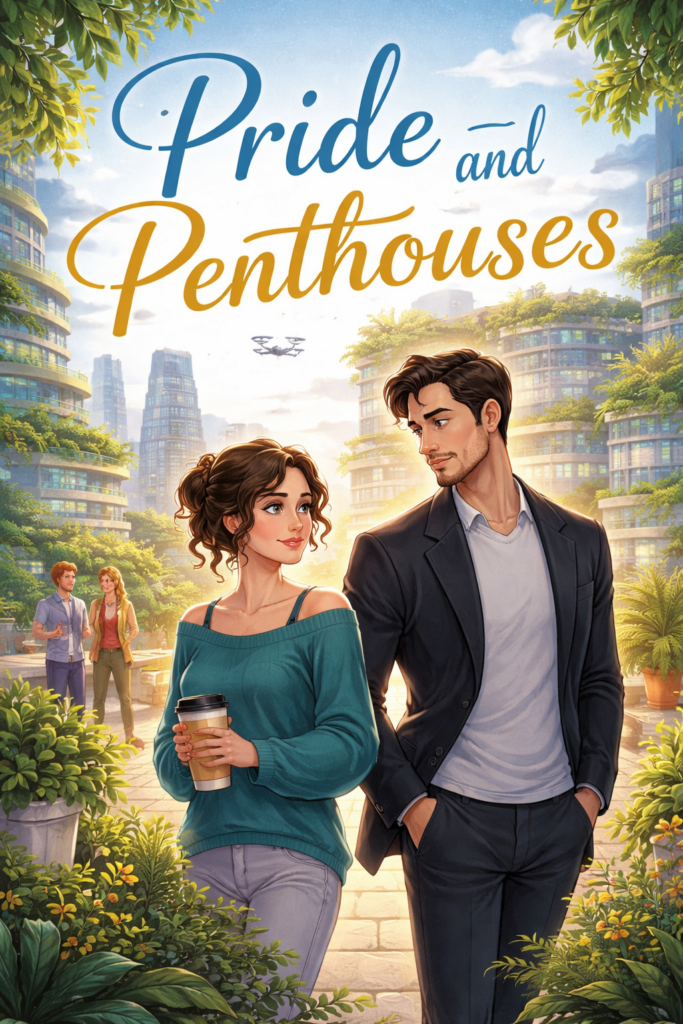
Works Cited
ChatGPT – Story and Cover