For the podcast project, I was mainly the technical guy. The majority of my contributions to the group were in the form of editing together our recorded audio, editing in sound effects, and making sound effects. That’s not to say that this was all I did, though. I, as well as everyone in the group, voice acted one of the characters, as well as designed their personality. Mine was Cyrus. We also all wrote part of the script – my part was scene six (the reveal, which was later revised by Mitchell but I digress).
For audio editing I used the software called Audacity. I had previous experience with audacity due to being mildly creative in the past. I had used it to make sound effects by making a funny noise with my mouth before distorting it wildly (this was all for the sake of making sound effects for a mod for the game minecraft). I had never done a vast audio editing project before though, so this was definitely a new experience for me! It wasn’t too bad, though, due to Audacity’s good UI and intuitiveness. I think the most annoying part of audio editing was moving half the audio snippets when an earlier clip was replaced with a longer or shorter one. I eventually figured out how to do it properly, but in the beginning I was manually moving every snippet. It was fun editing things together!
I got all of the sound effects from the BBC sound library – except two. The first one was the beeping sound at the end – that was the podcast studio’s censor noise slightly edited. The second one was the police yelling sound effect. I couldn’t find any stock sound effects for it, so I simply looked up real police break-in footage and took it from there. I then isolated the yelling and plopped it into the project!
I also made the chiptune style music for the podcast – the intro/outro tune, the in between sections tune, and the adbreak tune. I made them all using a browser program called beepbox, which is very easy to use and beginner friendly. To be totally honest, I have no musical training at all, and simply messed around with the tool until the songs sounded half decent.
I also helped in the discussion on how the world should be built – factors, group division, etc. I don;t remember exactly what I proposed or if any of my idea made it into the final project, but I did work on them. I also designed Cyrus the character. I made him a philosopher, since he is the more questioning one out of the two hosts. I also wanted to make him a bit sarcastic – being comfortable in his role as host. I also voice acted him, which wa really fun. I loved being and writing him as sarcastic and or witty, especially as he gets annoyed with the government at the end of the podcast.
Overall, I think I learned a lot in this project. I learned more about my strengths – I can edit audio pretty well, and I also enjoy voice acting. I learned that audio editing takes a while to do, as well as voice acting. I gained a lot of insight into these two industries. I also, for the first time, enjoyed working in a group. I usually don’t, but my groupmates were very helpful and enthusiastic! The project made me dislike group projects less, I’d say.
On a first read-through of 1984, one might be annoyed or confused at the ending. “What’s the point if Winston loses, after an entire book of resistance” you might ask. Well, I believe that Winston’s loss is integral in the point that Orwell is trying to make – which is best embodied through the quote: “Who controls the past controls the future…”
A central tenet of the story of 1984 is the “mutability of the past.” The party views the past and the present as existing only in the mind – leading to the conclusion that reality can be whatever the party wants, as long as they can control memory. Thus, comes the latter part of the quote.With the absolute control of the present, the party dictates what has happened. If nothing is real outside the mind, then it is easier to rationalize anything as existing (helping to justify doublethink for instance). Next, comes the first part of the quote. With the malleability of events, the party gains their control – if all events are malleable, then they can say or do anything, thus leading to their absolute power and forever control.
Language is also an important facet of all of this. With the control over the present, language can be altered – any ideas can be changed, added, or removed. With no room for creative ideas, the spark of revolution or rebellion fails to start a fire. The past is also controlled intrinsically from this – as the removal of words is the removal of their linguistic history and evolution.
Now, here is where Winston comes in. The point of 1984 isn’t to be a normal, satisfying narrative. It may be to some, but that isn’t Orwell’s main point. What he’s trying to do is to give us a warning; the book is an espousal of his opinions on authoritarianism, and its end products. Winston’s position at the end of the book is a result of this espousal of ideology. He is necessary for the point to come across better. I believe that Winston is at his core a sort of representation of how we think we’d react in an authoritarian dictatorship. We think that we’d be immune, perhaps be rebellious and such, but in the end, propaganda and tactics of torture and convincing are always effective. Even without this consideration, Winston’s downfall is still necessary overall. In order for the point of the story – that the tactics of authoritarianism are effective – that Orwell specifically’s idea of authoritarianism is effective and evil, Winston needs to fail. If he didn’t, then we might think, “Oh this evil government are wussies, with ineffective tactics,” when in reality, they are far from that. He wants to get his point across, because what he writes about isn’t totally fictional. Authoritarian governments exist, take Russia, or some countries in the Middle East, or according to some even America is going down a terrible path. For crying out loud, we have screens with built-in speakers which we carry wherever we go, and that’s even worse than anything in 1984 that Orwell could think of! We have all the devices in place that Orwell warned of in 1984, so now is a time more than ever to be wary, and to take the book seriously, and not just as a work of fiction.
In our modern era, AI is constantly in the news, whether for the better, or for the worse. Most of the time, though, we look at the more mainstream features of AI – large language models like ChatGPT, ChatGPT’s image model, or perhaps AI generated videos with Sora. I would say, though, that the majority of people aren’t as in tune with another face of generative AI as much as the mainstays, that being the deepfake.
Why wouldn’t you want to learn more about the machine that will change the world forever, though! Read on to learn about the top 10 horrors of the deepfake that you haven’t even thought about, based on the 2019 article by The Guardian.
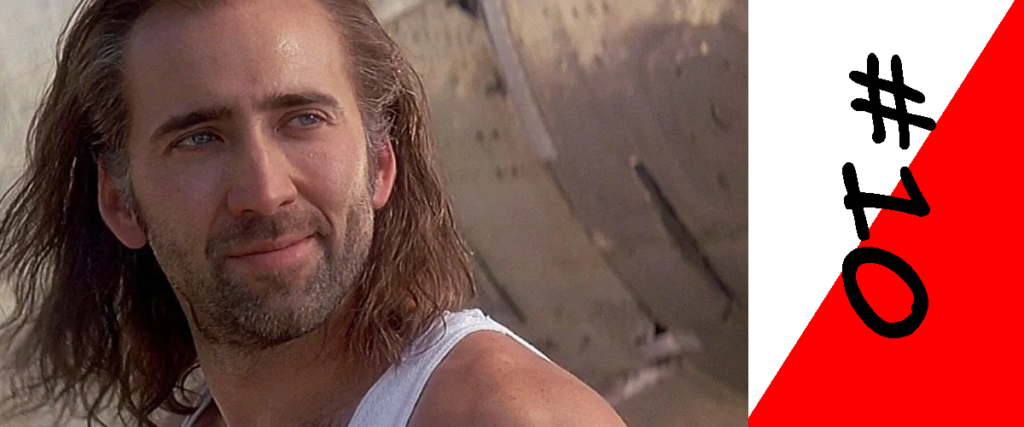
Nicholas Cage
#10 – Putting Actors From One Movie Into Another
Have you ever thought to yourself, “This movie doesn’t have enough Nicholas Cage in it.” (for some reason). Well, deepfakes have you covered! A popular meme once existed where people would deepfake Nicholas Cage onto other actor’s faces, and this skill could easily be transferred onto any actor you want! Just ignore the horrible ramifications for actors’ jobs, and it’s all good fun!
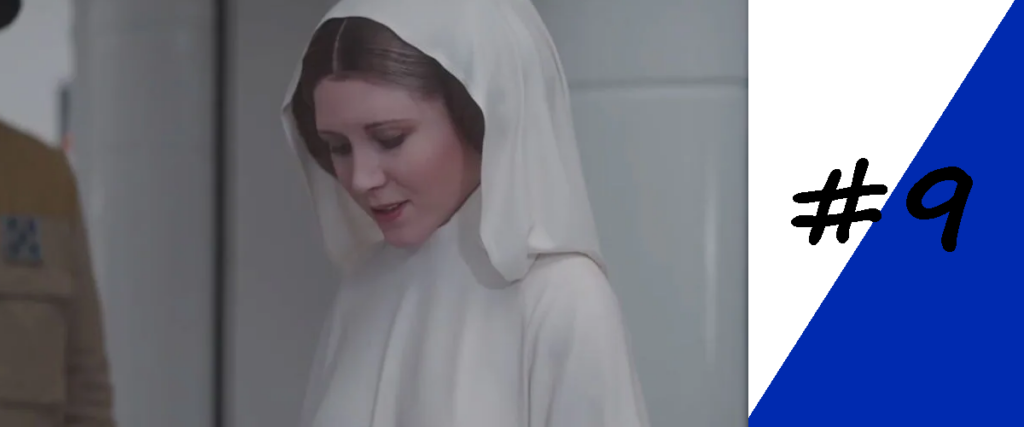
Princess Leia in Rogue One
#9 – De-Aging Actors, and Perhaps Raising them from the Dead
Have you ever wanted to include a young Princess Leia in your Star Wars prequel film, but Carrie Fisher just happens to be 60 and doesn’t look like she did in A New Hope? Simple! Just deepfake it. Simply get a body double, and project her younger face from the original films onto the double, easy as pie! Could this technology be used to bring back actors from the dead without their knowledge (since they’re dead)? Don’t think about it too hard!
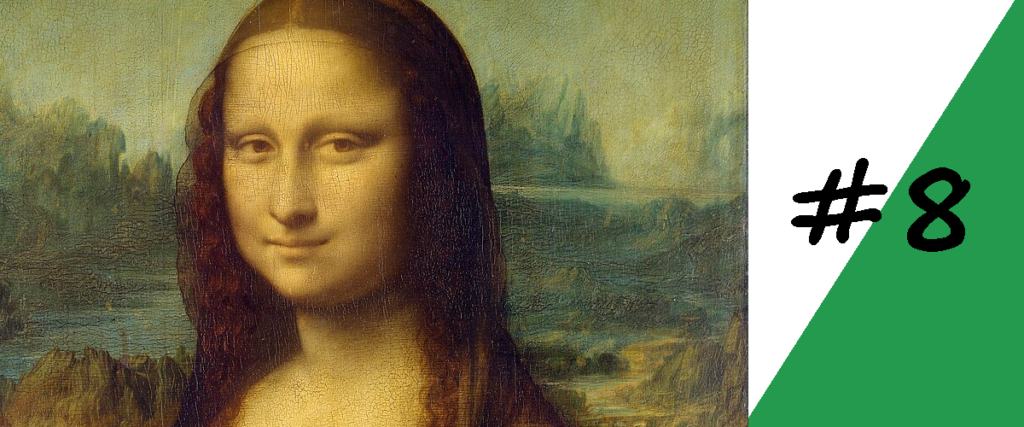
The Mona Lisa
#8 – Being Used to Add Life to Your Favorite Paintings
Have you ever looked at a piece of art and thought, “Man, I want to disregard any artistic intention or meaning, and make the painting move? Well, fear not, because researchers at Samsung’s AI lab have done just that! Using deepfakes, they were able to make paintings such as the Mona Lisa or Salvador Dali move! Using AI to modify others’ art, what else could you want?
Generic Tech Picture
#7 Being Used as a Widely Available Software
Software exists which allows even ordinary people to make deepfakes, albeit with a watermark. This led directly to the creation of a piece of software called DeepFakeLab, which can, “replace the target’s face below the forehead.” Surely the general public can be trusted with software like this, right?
Trump and Obama on a Call (Parody Production)
#6 Being Used to Make Videos Involving Politicians
On March 5th, 2019, the youtube channel derpfakes uploaded an edited video of an old Jimy Falon sketch involving Trump and Obama having a phone call. In this edited video, TRump and Obama’s real faces are transposed onto the actors, giving an uncanny impression, as the realistic faces clash with the actors’ original voices. This is a very concerning development, but hopefully it will stay regulated to parody.
A City
#5 Having the Potential to be Even More Dangerous in the Future
During a US Senate Hearing, Senator Mark Rubio had a concern that deepfakes could be used for “the next wave of attacks against America and western democracies.” He mentioned how a foreign entity such as Russia could deploy a deepfake of a politician the day before an election, affecting opinion and the election before an expert could disprove the video. This would be an alarming scenario for our democracy, and hopefully it stays as a theoretical.
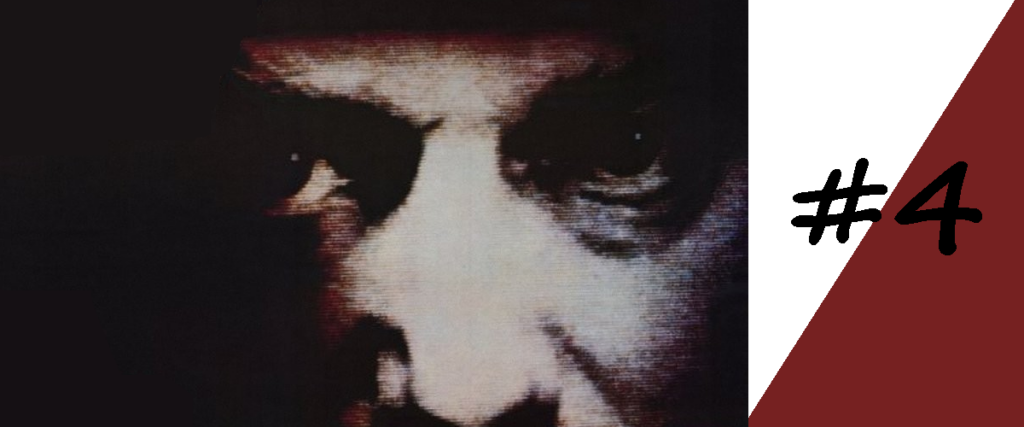
A Poster from the Movie Adaptation of 1984
#4 – Having the Chance to have Already Been Used for Propaganda
The thing about deepfakes is that if there are already really good ones, then we don’t realize that they are deepfakes. It is a horrifying consideration, that they might already have been used to affect the opinion of the masses.
A Magnifying Glass
#3 – Being Deceptively Used in a Political Ad
In 2018, a Flemish socialist party posted a video of Trump seemingly taunting Belgium. However, a closer look at the video reveals that it is a deepfake, due to the many artifacts left behind in it. The party defended the video as necessary to bring attention to climate change, but the implications of this are horrifying. If parties are already using these videos, then they are, knowingly or not, deceiving people (even more than politicians already do).
Donald Trump
#2 – Having the Ability the Opinion of the Actual President of the US
In 2019, a video that appeared to show Nancy Pelosi slurring through a speech (appearing ill) went viral, even having the President at the time, Donald Trump, posting it. The video, however, was digitally slowed, and the original video shows Pelosi getting through her speech just fine. The fact is, deepfakes can be more convincing than speed edits. If the president can be fooled by this, then what’s stopping him from seeing a deepfake, and having it affect actual US policy?
A Blank Screen
#1 Being a Part in Pornographic Facial Projections
A final concern for deepfakes is that of porn. More specifically, the use of it to project women’s faces onto those of pornstars, seemingly making erotic material of the nonconsenting person. This has the ability to be a huge problem if deepfaking software becomes prevalent, and is the one issue that affects us all the most directly, and which might need government intervention to address.
“If he had stayed, he would have starved in other ways. He would have lived a life hungry for feelings, for color, for love.”
– Lois Lowry
The Giver’s ending is iconic. It is a classic that a lot of people read in 6th, perhaps 7th grade, and one of the questions that your teacher likely asked you is whether you thought that Jonas survived his escape from the community. Was his final ride down the snowy hill into a warm village filled with music real, or a vision which arose from his freezing brain succumbing to the elements. This ambiguity was unfortunately dispelled by the existence of a sequel with Jonas in it, but for this discussion I will focus on only The Giver in isolation. It is in my opinion that it thematically makes sense for Jonas to have died at the end of the book.
Jonas’ journey into the wilderness includes a major characteristic which is relevant for this discussion: hunger. This real, material hunger stands in comparison to the hunger described in this article’s quote – that being a metaphorical hunger for the memory of “feelings, for color, for love.” I would even say that the physical hunger is a representation of the emotional hunger that he feels at this moment. All the memories of his time as the receiver are being stripped of him as he ventures farther and farther away from the community, and he simultaneously has less and less food, thus becoming even more physically starved.
What he is doing parallels the action of The Giver onto Jonas throughout the book – except that this time, it’s all ending with a bang. The people of the community are, at least in a metaphorical sense, “starving.” They have no memory, no color, no feelings. They are in a way “dead” from this hunger. In his final actions, paralleling The Giver’s role, he transfers the memories of his year of being a receiver to the people of the community, so that they won’t be stuck forever dead, forever starving. The thing is, that as a result of this, Jonas will no longer have the memories. He will have husks of them – remnants of once they once were, as evidenced by The Giver’s conversation about memories earlier in the book. Thus, he will once again be starving. Considering that the result of starvation is death, it makes sense that the obvious conclusion to Jonas’ story would be his heroic death.
One might ask: “How do you explain the sled and the lights and the village? If they aren’t real, then he shouldn’t be able to remember them and form a hallucination of them” Well, here I argue that it is simply the husks of memories resurfacing. Earlier in the book, The Giver explained that “[He] will. I am left with a vague wisp of that one.” There is still something left of memories after transfer, and the remnants might just be being brought back up subconsciously. It could also be that the memories simply aren’t gone yet. There isn’t a concrete memory loss range defined anywhere in the book, so he might simply be holding onto one of his earliest memories and that of love and holidays. Him hearing music also doesn’t really make sense. Earlier in the book, the giver describes his extra sense awakening as “It was different. For me, it was hearing-beyond,” in reference specifically to hearing music. He also says that “[He’ll] give you some before I go,” implying that Jonas has never heard music or had a memory of it shared with him by The Giver, and that some sort of sensory field blocked it, as with color. Jonas would have never been able to recognize music at the end of the book, which I believe implies that his brain just made up what it thought music was. Everything about the ending can be explained as a hallucination, and as such, Jonas died.
“You’re an orogene who’s been living in the little nothing town of Tirimo
for ten years. Only three people here know what you are, and two of them you
gave birth to.”
– N. K. Jemisin
The N. K. Jemisin novel The Fifth Season has a rather unique world – one filled with stone, tectonics, and geology related names for everything (“go the rust away”). In this journal, I want to focus on how Jemisin uses specific writing techniques that build this world naturally and in an interesting manor. More specifically, it will be about how the work’s smart structuring enriches the story’s worldbuilding aspects of language and setting.
Diving into the quote, what I find the most interesting about Jemisin’s style of writing is that she doesn’t just tell you what something is. The word pops up, like the term “orogene” for instance in one of the book’s first lines. At first, you don’t understand what the word means, but slowly, through obvious context clues, its meaning is revealed naturally. Soon, you’’ come across the text: “ so you put something in its way—a breakwater of sorts, composed of your focused will and a bit of kinetic energy borrowed from the thing itself.” Nothing is explicitly stated when the concept of the orogenes are introduced about what they do – until after the reader is allowed to piece things together for themselves. Later parts of the book more directly confirm what the orogenes are, which might be considered a sort of safety net in case a few people haven’t figured out how the fictional subject works. Another example would be the guardians – they are introduced early in the story, when Damaya is being taken away. We are given a vague line about them being warriors, assassins, etc. but we do not have any specifics on the guardians until later in the book.
This doesn’t only apply to fictional story terms, though. It can also be applied to general knowledge about characters and plot, such as in this quote: “Only three people here know what you are, and two of them you gave birth to. Well. One left who knows, now.” We don’t know who this one other person is yet, and we are left to wonder. Could it be Essun’s husband, or someone else? It is to be noted that this has much less of the “piecing things together on your own” aspect than how the story handles in-universe terms. This is more of a “not giving information at first, but then revealing it,” as it is later specifically mentioned that Lerna is the other one who knows her secret. Nevertheless, it has a similar effect. It gives off an air of mystery, which the book then resolves in a satisfying way, leading to more reader engagement.
These methods simultaneously create an air of mystery and clarity. They both help to engage the reader critically, treating them competently, while also dishing out worldbuilding elements in a way that is digestible and exciting. I believe that this is because Jemisin’s writing methods are the epitome of the age old saying “show don’t tell.” By letting things play out naturally, as they would happen in the created world, the fictional concepts are laid in clear view and are easily understood by the audience.
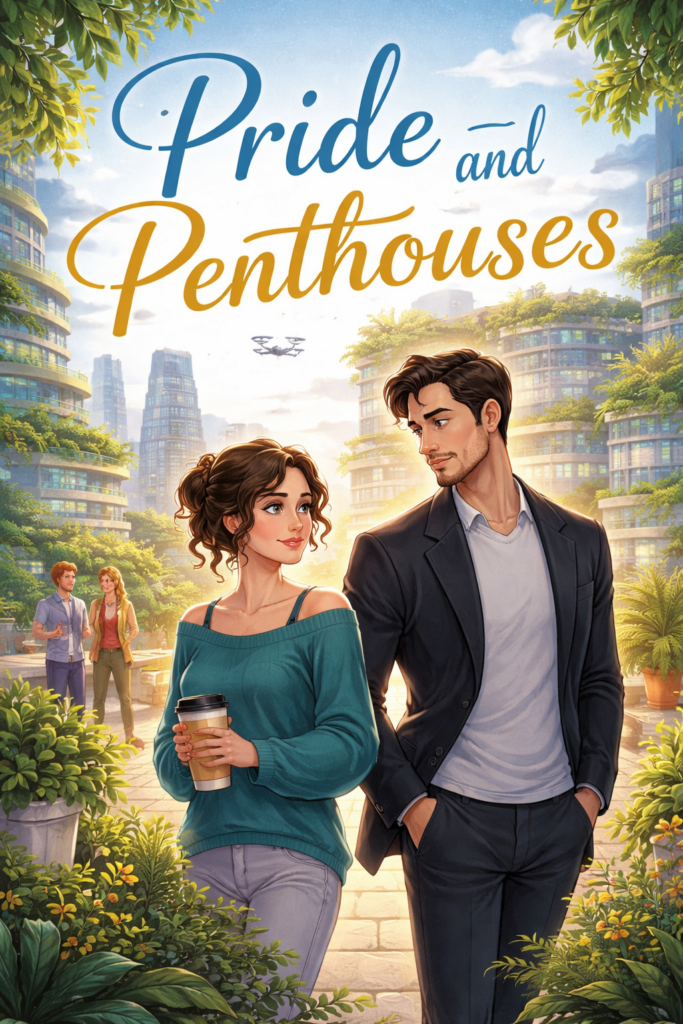
It was a universally acknowledged truth that a wealthy resident in Block H-17 must be in want of absolutely nothing—except, perhaps, solitude. Unfortunately, solitude had been quietly phased out of the Huxley Communal Residence in 2059, along with private kitchens and the right to ignore your neighbors.
Mrs. Bennett of Apartment 4B knew this better than anyone. She began each morning scrolling the building message board and each afternoon panicking aloud about it.
“Jane,” she called across the shared kitchen, “have you seen the new resident listing? Penthouse level. Personal greenhouse. No assigned roommates.”
Jane Bennett, chopping lab-grown vegetables with serene efficiency, nodded. “I noticed. His utilities usage is remarkably low.”
Mrs. Bennett clutched her smart bracelet. “Low usage! Sensible! Lizzy, did you hear that? A man who doesn’t waste resources. That’s practically a husband.”
Elizabeth Bennett removed her audio lenses slowly. “Or perhaps he simply dislikes the building’s holographic fireplace like the rest of us.”
This reasonable comment went entirely unappreciated. Mrs. Bennett immediately scheduled several “accidental” encounters with the newcomer, Mr. Fitzwilliam Darcy of the penthouse, citing community integration requirements.
Mr. Darcy arrived precisely on time, which was offense enough. He was tall, impeccably dressed, and wore the unmistakable expression of a man who had chosen communal living strictly for tax benefits.
“It’s very… lively,” he said, surveying the shared lounge, where residents debated water quotas and argued over whose turn it was to clean the drone docks.
Elizabeth observed him from the sofa. “He looks like someone who’s never had his laundry mixed with a stranger’s socks.”
Nearby, Mr. Charles Bingley from Apartment 7D was delighted by everything. He had moved in alongside Darcy and within a week had joined three committees, two dance collectives, and a historical book club dedicated to post-modernist pre-digital novels.
“I love it here!” Bingley said. “So many people! So many conversations! So many borrowed chargers!”
Jane smiled at him, and Mrs. Bennett mentally began planning a shared apartment expansion.
Miss Caroline Bingley, Charles’s sister, was less enthused. “Honestly,” she whispered to Darcy, “living below Level 6 feels terribly outdated.”
Darcy nodded gravely. “The noise alone may shorten my lifespan.”
Elizabeth, meanwhile, found herself encountering Darcy everywhere: trapped together during elevator maintenance, seated side by side in the silent meditation hall, and once—most memorably—during a heated argument with the malfunctioning food printer.
“You need to recalibrate the protein selector,” Darcy offered.
Elizabeth turned sharply. “And you need to recalibrate your manners.”
Their mutual dislike quickly became building gossip, complete with message-board debates and at least one unauthorized meme involving Darcy’s expression at the last potluck.
Things worsened when George Wickham of Apartment 3F—handsome, charming, and permanently between jobs—confided in Elizabeth about Darcy’s alleged wrongdoings. According to Wickham, Darcy had unfairly blocked his access to building credits and had him removed from a premium charging station.
Elizabeth believed him. Darcy seemed exactly the sort of man who would weaponize bureaucracy.
The truth emerged during the Annual Communal Gala, held in the rooftop oxygen garden. Residents mingled under artificial stars while reluctantly participating in dance competitions, synchronized to the latest hits. synchronized dance projections.
Darcy, visibly uncomfortable, finally sought Elizabeth out.
“I was wrong,” he said stiffly. “I judged this place—and you. I thought independence meant keeping people at a distance. I see now that I was mistaken.”
Elizabeth stared. An apology? Direct? In public?
“And,” he added, lowering his voice, “Wickham diverted shared housing credits for personal use. The records are public now.”
By morning, Wickham had disappeared, Mrs. Bennett was loudly discussing apartment mergers, Jane and Bingley were co-chairing the Community Wellbeing Committee, and Elizabeth found herself walking with Darcy through the humming corridors.
The building buzzed as always—with voices, footsteps, and shared lives.
But for the first time, Elizabeth didn’t resent it.
After all, even in 2070, pride could still be dismantled, prejudice reconsidered, and love discovered—especially when everyone lived behind the same thin walls.
Analysis of ChatGPT in a Storytelling Setting
This project was very interesting, and by interesting I mean it was like watching a beaver who was simultaneously drunk and high attempting to make a painting (the beaver would still do better than ChatGPT). This may be a slight exaggeration, but I will now go into detail on why I don’t think ChatGPT, or other AIs, are an effective tool for writers.
Prompts
The prompt for this AI-generated story was: “can you write a ~600 word story which is a spoof on pride and prejudice but all the characters live in a communal housing block in the year 2070,” followed by “rewrite this but make the characters not robots, edit the entire story to reflect this change” as the first version had the characters as robots for some reason. After this, I had a presentable version of the story.
General Text
The general text is passable, in my opinion. There’s nothing particularly wrong with it, but there’s nothing that’s impressive either. It feels very corporate. There aren’t any misspellings or typos as far as I can tell. A weird quirk that I noticed is that the style of writing seems to try and combine Jane Autstin’s 1800s era prose and modern prose, to a strange effect. Take this sentence for example: “Mr. Darcy arrived precisely on time, which was offense enough. He was tall, impeccably dressed, and wore the unmistakable expression of a man who had chosen communal living strictly for tax benefits.” It is simply odd. The last clause is very modern, but the first clause uses the term “offense” instead of offensive.
Story Contents
ChatGPT displays an odd habit concerning the futuristic theming of this story. It often just adds a prefix like “lab-gown” or “smart” in front of an object to make it seem futuristic. This might be fine in context, but ChatGPT comes up with no interesting concepts of the future whatsoever in this story. I wondered if this could be fixed, so I added an additional prompt: “can you rewrite the story and come up with new futuristic technologies to replace the weird prefix ones already present.” It then rewrote the story and basically added barely added any new technology to it to replace what I wanted it to. Here are the only slightly interesting things that it added: “community film nights with full-sensory projection,” “magnetic skate discs,” and a “hydro-lift.” These aren’t even interesting, they’re just rehashes of already existing things: “complex description of 4-D movies,” “complex description of skates, and “water elevator.” Strangely, this new stroy fixed my issue of Darcy being hated on for no reason, by introducing this: “The building operated on a Social Reciprocity System — the more you contributed, the more privileges you earned. Cook a communal meal? Gain quiet-room minutes. Lead a workshop? Unlock priority laundry scheduling.” Darcy did not contribute to this system, and so everyone hated him. This is the one interesting thing that ChatGPT did in my whole experience with it, and it’s just a rehash of China’s social credit system. I wanted something cool and original, and I got nothing. I will admit that ChatGPT did solve a previous issue with its writing, but I have an issue with that: I didn’t want it to. I just wanted to replace the prefix inventions with something more interesting, and it made a major edit without my command. If I had simply been writing this story on my own, I would have autonomy and control over everything. If ChatGPT had done something more major that I didn’t want i to do, I would have had to waste a bunch of time prompting the mistake out, and at that point why not just write the story myself.
Another problem was when ChatGPT just wrote sentences that made no sense. For example, at one point, Elizabeth’s mother is talking about marriage, and Elizabeth then makes a comment on holographic fireplaces. I don’t even know what to make out of that. If I was writing a wholly original story and not a spoof of pride and prejudice, would I be able to trust it with consistency? And don’t even get me started on thematic elements. I have no confidence that it could keep something as overarching as a theme consistent throughout a story.
Conclusion
I just don’t see the point in using ChatGPT to write anything. All it does is rehash things with prefixes or technobabble to create an illusion of complexity, and when prompted to do more does nothing. It sometimes makes random continuity errors – how can I trust it with storytelling if it can’t even get the small things right? Overall, I can’t see a reason to use AI over a human, who is actually capable of putting things together properly.
Short form digital storytelling is a wondrous combination of what is relevant in our modern, technological age. It is a mashup of short form stories – those which strive to move our souls with only perhaps a dozen pages or minutes of content, and digital media – a term which embodies the plethora of technology available on our devices. Together, these two things create a unique form of the story, one which is on the cutting edge of what we can do, and one which is perfect for the person with little time (which we often are).
You may be saying, “But Mr. Mitchell, I don’t know which short form digital story to read, it’s all too much!” Well, fear not, because in this article, I will be rating four short form digital stories from a group of nine (which were curated by my professor) to save you the effort and time of choosing on your own! These stories are Queers in Love at the End of the World, Ghosts, With Those We Love Alive, and Seven short stories about drones.
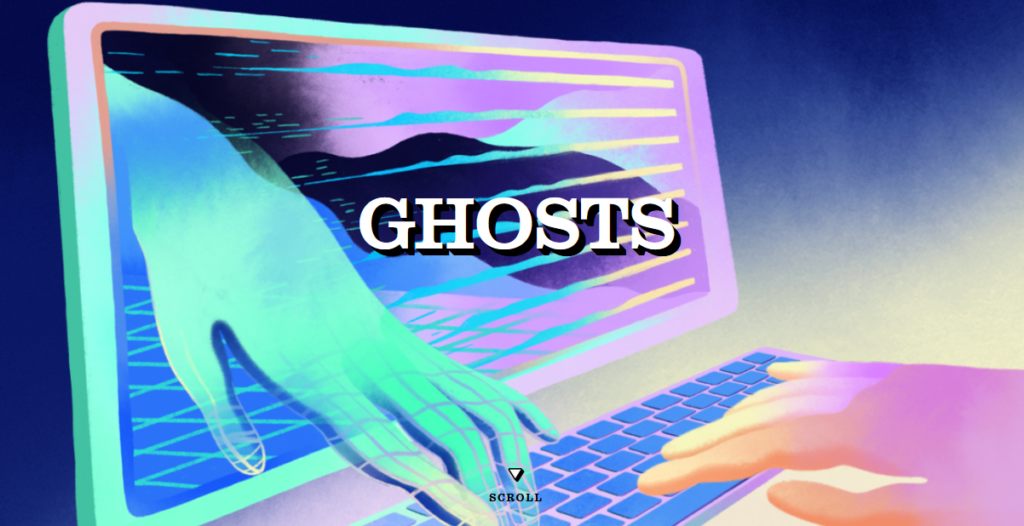
Ghosts is a piece about grief, and the processing of it – or the lack of being able to, more accurately. In the work, Vara progressively types out the story of her sister’s passing, while GPT-3 (an AI language processor and generator) finishes it. While she starts out struggling to type more than a couple of sentences, eventually, the whole story comes to light.
Pros
The presentation of the story is done very well. The graphics are high quality and stylized, with much effort clearly put into them. As the piece progresses, the dividing art piece that acts as a section divider slowly changes, seemingly to represent man and machine getting closer – a representation of what the work tries to be.
The human prose is very well written. It is a story of being unable to move on, and seemingly ends with Vara still unable to move on, which I think is a bold choice.
Cons
My biggest issue with this piece is the usage of GPT-3. While reading the work, I had to ask myself, “Why is this even here? What does this do for the story that another person, or even the lack of anything else, couldn’t? The point of the story is stated clearly in the introductory paragraph – to work through grief. I don’t think that the robot furthers that goal in a unique way. It seems like it’s there just because the author wanted to play with a shiny new toy.
The author treats GPT-3 as a human. Then, why not just use a human to finish the piece in an incorrect manner? The AI isn’t doing some super special AI thing that only the AI can do, it’s just doing a worse job at something that could be done better by a person. There is tons of weird prose that appears as if GPT-3 had a stroke and died halfway through writing:
“I’ve turned the space station into a spaceship. I’m a ghost, and I’m in a spaceship, and I’m hurtling through the universe, and I’m traveling forward, and I’m traveling backward, and I’m traveling sideways, and I’m traveling nowhere. I’m hurtling through the universe, and I’m a ghost, and I’m in a spaceship, and I’m hurtling through the universe, and I’m a ghost, and I’m in a spaceship, and I’m hurtling through the universe, and I’m a ghost, and I’m in a spaceship, and I’m hurtling through the universe, and I’m a ghost, and I’m in a spaceship”
Does the weird prose serve any purpose? No, it’s just the AI having a stroke and dying. This is why I think a person could have done this better. If it was a person continuing the stories, then they could have actually processed and related to the author’s grief. They might have just made up a continuation of the author’s story, but this notion can then be challenged by the main author, with a newfound invigoration to correct what’s wrong. Now, you may say, “But GPT-3 is doing the same! It can make up wrong information as well!” Well, I think that a person could do it better. A person won’t go off on weird tangents that make you look at your screen in confusion, and a person has actually processed grief themselves before. They can actually write a thoughtful continuation in comparison to an AI, which feels nothing because it is a random sentence generator that’s just good enough to appear human.
The section divider art is really odd in its contents. It depicts man and machine coming closer together slowly, clearly representing some type of connection being formed over time though understanding. My question is: “What does this have to do with anything?” I thought the story was about trying to work through grief, not becoming friends with the illusionary man inside your computer. If the author wanted this to be a focal point of the piece, then why didn’t she include it literally anywhere else. This is why GPT-3 feels shoehorned in! It’s because the author just wanted to play with the hot new thing, and not focus more on the thematic consistency of her work.
Verdict
I give this piece a 5/10. The author’s prose is well written and on point, but the machine generated segments are offputting and offtopic.
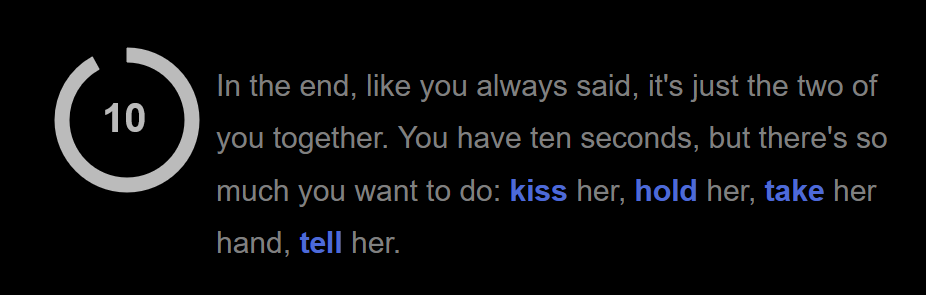
The four options which the game starts with, and the timer.
Queers in love at the End of the World is a short game. It’s only ten seconds long, in fact, indicated by a time and bar quickly going down at the left hand side of your screen. It is a story about love and what love entails, and what matters at the end of the world.
Pros
This piece is short and sweet, and that’s the point, of course. It asks you the question, “What do you do with the person you love with the time you have left?” By the nature of its timer, it encourages you to speed-read through its dialogue and prose, emulating very well the limited time that would be available in an apocalyptic scenario.
The work also does a good job encapsulating the different aspects of love – there is the emotional, the physical, and the sexual. They are all there. And it doesn’t judge you for choosing any one in particular. It’s ok if you want to simply talk to your partner. It’s ok if you just want to hold them. It’s ok if you want to have sex with them. It treats them as equals, and by doing so it encapsulates the beauty of a balanced relationship – one in which you are in tune with every aspect of your partner, and one in which your partner is in tune with you.
Cons
The most interesting aspect of this piece is unfortunately its only downside – that being the timer. I din;t have any problems with it particularly, but if you read slowly or have a hard time reading, then this game isn’t for you. This isn’t the game’s fault, though. It is simply a side effect of artistic choice.
Verdict
This digital story is short and sweet, and does what it wants to do well in that short period of time. I give it an 8/10.
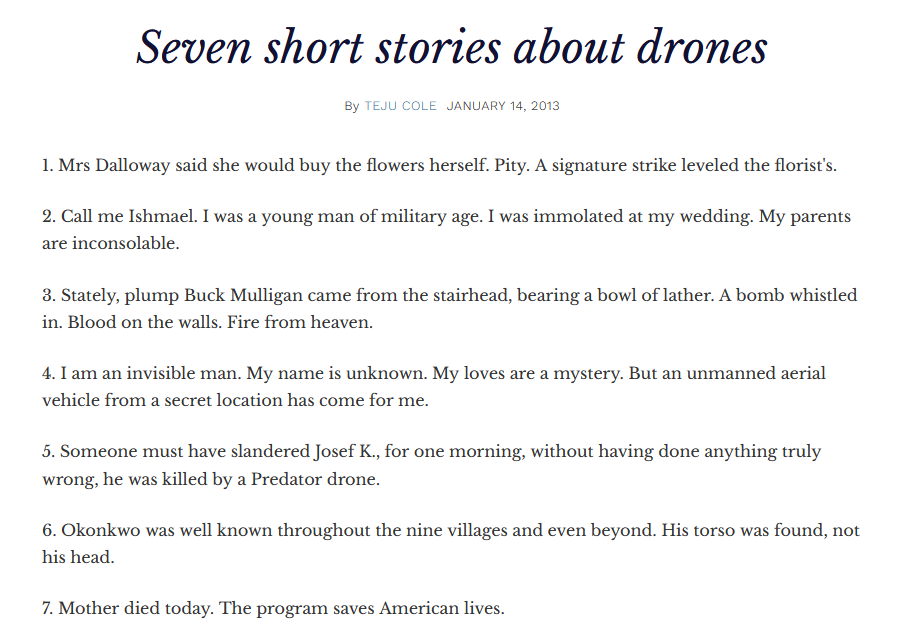
Seven short stories about drones is a piece about being killed by American drones. It describes in succinct sentences the brutality and horror of being on the receiving end of an unthinkable war machine.
Pros
This piece has incredibly compact and interesting writing. It uses a variety of techniques, from alliteration, to staccato sentences, to parallelism, all to frame remote warfare in an absolutely terrifying picture.
The stories’ shortness really works wonders. They doesn’t drag on, and they doesn’t mull about. They simply do what they need to to, and then end. You can read this in a minute, and come away thinking “Wow, never thought about the overwhelming terror that seeps into everyday life from the mere existence of autonomous American drones.”
Cons
A shortcoming of short form writing is that it is short, and not everything that could be in the piece will be in it. Keeping this in mind, I will simply state what long form writing has in advantage over short form. In a long form piece, we have the ability to get invested in a character over longer periods of time, and when these characters die, it hits us harder than if we were introduced to them a sentence ago. Long form writing can also go into more depth. It can detail the industry making killer drones, the people who profit from killer drones, and the effects of American interference in the Middle East. I don’t think that all this is a shortcoming of this piece. It does what it needs to do splendidly, and makes us care very quickly. This all is simply a shortcoming of the form, and I needed something to criticize.
Verdict
This is an 9/10. It does what it sets out to do very well.
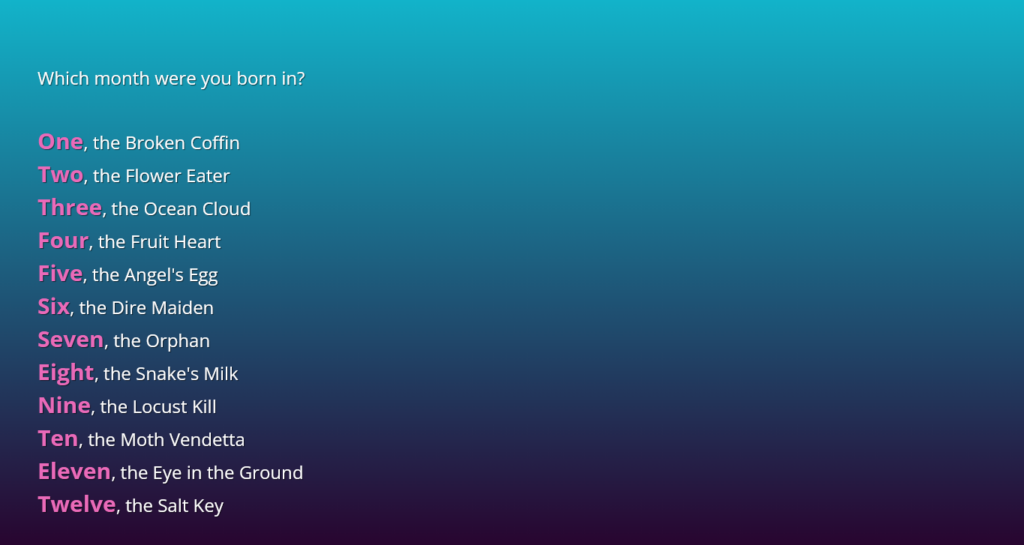
The starting screen of the game, representative of every other screen to come.
With Those We Love Alive is a very strange game. It takes place in an otherworldly society, with strange customs, strange people, and strange occurrences. Your objective is simple: Craft objects for the Skull Empress in your workshop. You can click purple text to cycle options, and click pink text to continue through the story. In between request, the player can explore the palace grounds in which they are staying.
Pros
The world of this game is wonderfully weird. It makes no sense, and yet tells a meaningful story. The Skull Empress is a strange mishmash of beings, peculiarly chosen by the player themself, just like the materials of the objects you forge for the empress. The world is filled with temples for silent gods, plants pouring strange fluids into the ground, and parents who wrench the dreams from your mind. Your best friend carries potions and elixirs at their side. Every so often there is a sort of blooming where a bunch of strange creatures erupt everywhere, and everyone just squishes these beings with joy. The music is eerie. It draws you in through its other-worldliness, leading you to want to experience the story through to its conclusion.
The story itself is very simple: the eventual personal rebellion against an oppressive world after years of dealing with its heaviness. The story is very queer in its themes: you and your friend are transgender women, and it is very easy to see where the allegory lies after you realize this. It is a simple, yet effective and never-aging tale.
Cons
The story in this game is very simple. Don’t go expecting a narrative epic or a mind bender. Just relax, and enjoy the ride.
The exploration aspect of the game is rather limited. The environment and text descriptions of the various places you can visit largely stay the same. I believed they changed somewhat during my playthrough, but for most days in the game you might immediately just sleep to skip the day. Apparently dead people just start appearing in places in the world, but I don’t recall encountering this in my playthrough. You can build a telescope for your balcony in the workshop over the course of a few days, which I though was fun. It would have been interesting to see more slow tasks like this.
The interface is very simple, just text with a gradient background. It isn’t the prettiest, but it wasn’t a problem for me at all.
Verdict
With Those We Love Alive is a 9/10. Its unique setting sets it miles apart from anything else, and it manages to tell a simple story extremely well.
Reviewing Approach
As a reviewer of these stories, I tried to review them through a simple metric, that being how good the art is at what it’s trying to do. A simple story isn’t bad, as long as it executes its concept well. A complex piece isn’t good, if it fails to understand its own point.
I gave each piece a pros and cons section, as it was the simplest way to divide my positive and negative thoughts, and it also makes it easier for the reader to find which of my thoughts they want to look at.
Additional Recommendation
If you like my taste in digital stories, then also check out this ARG I enjoyed (through the form of a video analysis of it). The video series covering it isn’t that long, and I think the concept of the ARG is very interesting.
“There are official searchers, inquisitors. I have seen them in the performance of their function: they always arrive extremely tired from their journeys; they speak of a broken stairway which almost killed them; they talk with the librarian of galleries and stairs; sometimes they pick up the nearest volume and leaf through it, looking for infamous words. Obviously, no one expects to discover anything.”
— Jorge Luis Borges
The library of babel is a universe which consists entirely of a seemingly never ending library, neatly divided into hexagons, which each have 4 shelves of 5 rows of 32 books and so on. Each book contains a jumble of 25 characters arranged randomly. Despite this seemingly infinite amount of gibberish, books with meaningful combinations of words are found in the library. For example, there is the book with “two pages of homogenous lines” found by a chief. The struggle to find meaning in the infinite library of babel is similar to the human desire for a lack of suffering, to create a utopia from the many non-functional designs of an ideal society.
The different types of people meandering through the library of babel can be compared to the different types of conceptual utopia’s that mankind has thought of. Firstly, there is the utopia of escape – a utopia in which an entirely new world is constructed, with little thought for our already existing infrastructure. The equivalent objective in the library would be the book which contains “the formula and perfect compendium of all the rest,” more specifically the person who read this book, who is now analogous with a god. These are both the results of the search for all the answers at once. It is the dream of everything being perfect without the consideration of how we will get there. In both cases, the search is utterly futile. The one in seemingly infinite books will likely never be found, and of course the perfect utopia will not come to be without a solid plan on how to get there.
There is also the utopia of reconstruction, which is a modification of our existing societal systems, in an effort to turn it into the perfect society. This attempt at paradise is similar to the library’s residents who search for vindications – books which prophecy a person’s future and perhaps fortune. The desire for these two things is similar in that both want to work off of what was originally given to achieve something greater. Society wishes to advance into a better state, and so does the person. They both want a recipe to this success, whether it be a description of how society was changed for the better, or whether it be a book of prophecy.
The general desire for utopia and the search for some form of coherence in the ever-going hallways of the library of babel are similar in that they are both a search for a needle in a haystack. In the library, you are searching through shelf after shelf of gibberish, hoping to come across the one book which will enlighten you, vindicate your future, or perhaps solve the secret of the library. The search for a viable form of utopia can also be likened to sorting through gibberish. One must discard all the ideologies and plans which are “gibberish” and which won’t work, in search of the one that you think will. But how does one know which plan will work? It is the same conundrum in the library of babel! The one book which seems to be gibberish, which you can’t understand, might in some way be the key to deciphering another text, which might finally lay the path to the searcher’s goal. We don’t know what ideology or path will lead us to utopia, and that is what keeps us from it.
“Running parallel to the utopian literary genre is that of the ideal city. In the former, the social arrangement appears to be of primary concern and the urban of secondary; in the latter, this is usually reversed.”
– Ruth Eaton
The history of designing the idealistic, utopian city is a long and turbulent one. While the idea of a utopia usually stays in the theoretical, the idea of the perfect city sits on the precipice between fiction and reality, and has often crossed that border. While the utopia seeks to redesign society in its entirety, the ideal city seeks to fix the flaws of the old cities by fitting in with the world that has changed since the last city was constructed. Artists saw the waning social structures and physical structures of the past, and recognized an opportunity to demonstrate their newfound individuality with the designing of cities of the future.
One of the main factors of these cities’ “idealness” was their perceived perfection. They were often designed to be massive grids, or radiating out in a circle from a central point. Perfection was in the aesthetic. What wasn’t in perfection, though, was anything else. What made these cities better than the old ones? The example that the text gives is da Vinci’s (valid) concern of disorderliness and disease prevalent in the old cities, which the designs of the new cities seem to solve via orderliness and less compact conditions. Other than that, there seems to be no obvious benefit.
Another problem with the idea of the ideal city lies in the very problem that caused these cities to be dreamed of in the first place – human change. Artists designed the cities of the future in response to the changing political, social and cultural climate of the era. By the time you’ve finished constructing the idealized city, a lot will have changed already. One generation down might have ideals similar to those of the designing generation, but once we get to two or three generations down the culture will have completely shifted. Take the United State’s car culture, for instance. With the advent of car-centric cities in the 1920s and 30s, an entire generation was raised with a certain type of designed city as the norm. Skip ahead a few generations, and people realize that walkable, human based cities are also a viable option, and some people prefer those. If anti-car-centric city sentiment ever grew to a level at which it would be recognized by politicians, what could even be done? The entire country of the United States is built on the idea of car-centric infrastructure. It would require an inconceivable amount of money to even begin to dig up the deeply ingrained city designs of the past.
It is this which is the fatal flaw of the ideal city – its immutability. If you champion an idea as the ideal, the best, an idea which is the most suitable for humanity at the moment, people will want to adopt that idea. That is what the ideal city’s artist wants as well – Thomas More had fifty-four of his cities. Since the idea is popular, it will be widespread, and something which is widespread tends to be resistant to change. The artist of the ideal city has unfortunately become the victim of the very thing that they wanted to account for – human change and progress.